


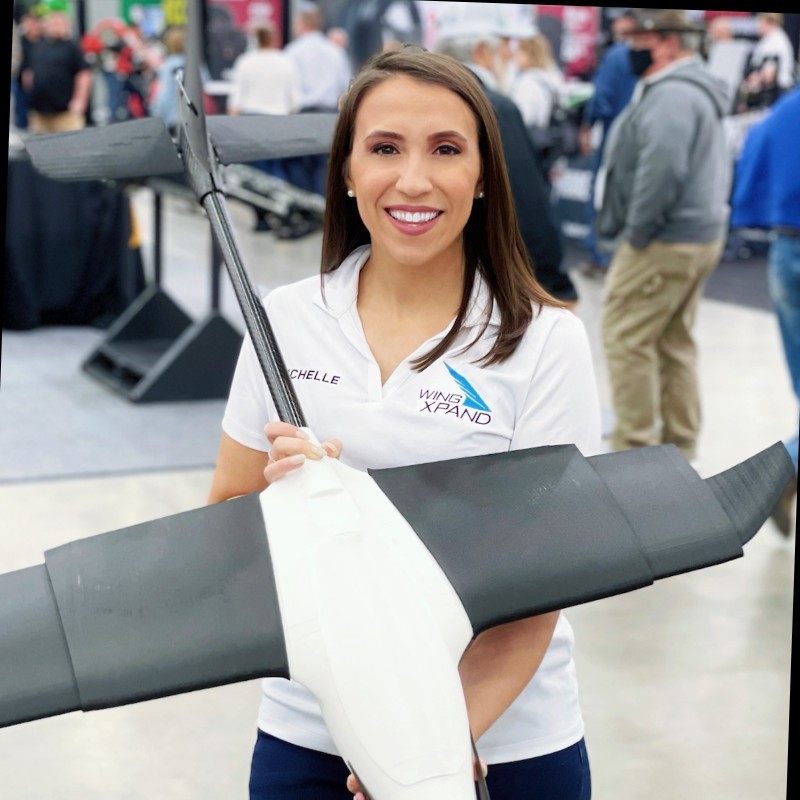
An Interview with Michelle Madaras, Co-Founder and President of WingXpand.
She was a successful TV journalist in a major market before becoming a founder of a drone startup. What was her motivation and how is it working out? That’s the story I explored in an interview with Michelle Madaras, President and Co-Founder of WingXpand, a 2022 Women and Drones honoree for Top Company: Women in Emerging Aviation Technologies.
Michelle spent nearly a decade in broadcast news starting as reporter back in 2012. She then went on to anchor at the ABC affiliate, WSIL, before heading to KTVI Fox 2 News in Saint Louis, Missouri. She then transitioned into marketing and communications, starting a consulting firm that supported a $100M local non-profit among other organizations. The move looks logical and deliberate, but then came the step that seemed out of place; one into the drone industry.
In early 2022, Madaras co-founded WingXpand, manufacturing Group 2 small UAS (sUAS) aircraft. Success came fast with contracts from the U.S. Army, U.S. Air Force, U.S. Navy and U.S. Special Operations Command. Today, the company is headquartered in Schaumburg, Illinois with manufacturing facilities in Missouri. WingXpand is growing and the team has expanded their market to support regional and state governments like Montana.
Michelle explains that her field journalism experience exposed her to the immense utility of unmanned systems. Covering various news stories like floods, fires, active shooters, even agricultural and big construction showed her how these systems could support various efforts. That said, it was the gap in capability and flexibility that stuck with her.
Talking about the use of those first-generation drones, she explained, “It was novel for what it was, but it really wasn’t holistically meeting the needs of professionals. I would commiserate with some of the first responders when we were out on the scenes together. They’d say, ‘The camera feeds are so-so. You can’t really see what you’re looking for.’ And, if you just had a tornado rip through your town, you might not have communications because a lot of these drones operate off WiFi. Well, that’s assuming that you have WiFi, which might not be the case. These were problems that I routinely saw out there in the field and I experienced as a journalist. But it was a much worse day for the first responders. Those folks in the field, like me, were trying to use these things to save lives, to improve their operations and so forth. And, so that’s kind of how I came into it really.”
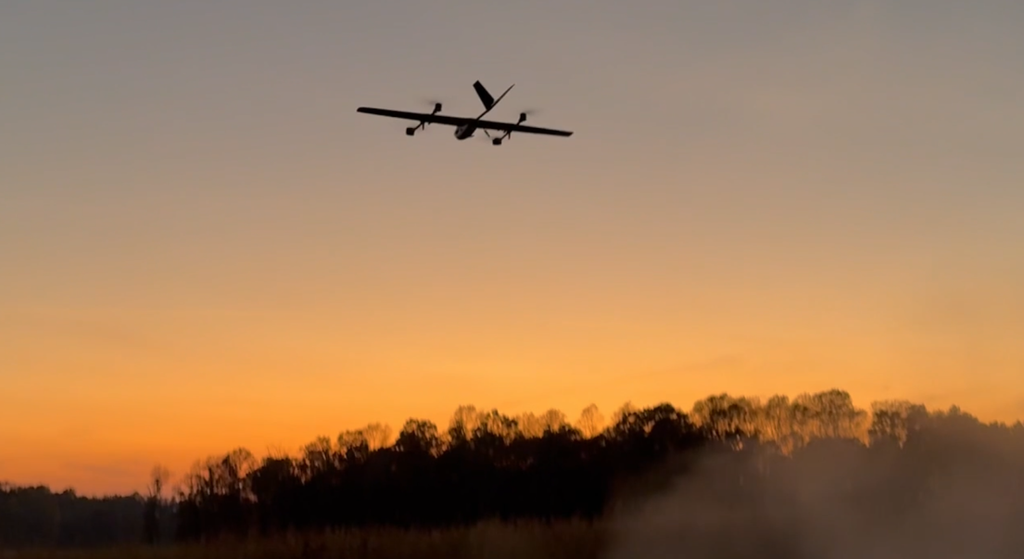
The idea of creating a new type of drone, one that filled those gaps, was born. Madaras explains that much of the discriminating technology, such as telescoping and detachable wings, came before the company even started. Her co-founder, James Barbieri, had seen other needs from his association with the intelligence and defense community. The two of them saw how a modular, man-portable sUAS would have a strong market.
Madaras points out that the rapid development and deployment of WingXpand came in large part because of innovation cells within the Department of Defense. Organizations like the U.S. Army XTECH and the U.S. Air Force AFWERX were instrumental in getting early visibility for their products. Madaras says the customer-driven mindset they put in place early on has led to the most recent expansion of WingXpand’s product line. The move from sUAS to drones that operate on the ground and in the maritime environment answered the call from a real-world operation gone wrong.
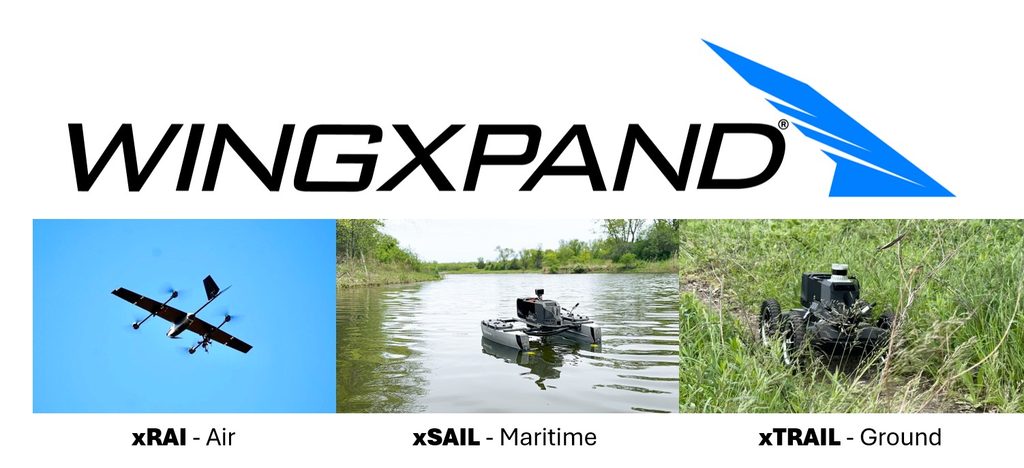
After two Special Operations personnel were lost inspecting a booby-trapped tunnel, WindXpand was asked to create a set of unmanned ground and waterborne systems that could be as smart and portable as their sUAS. After reviewing the problem, a family of systems was created that use the same central payload. That payload includes autonomy software, self-creating mesh networks communications, GPS-denied navigation, and sensor suites. This “brain,” xPAIR, can be incorporated into the chassis of three unmanned vehicles – xRAI for air, xTRAIL for ground, and xSAIL for maritime.
The gravity and determination were palpable as Michelle explained, “Our team moved heaven and earth. We moved quickly and we did that within 4 months. We built them a working prototype that they had in their hands, and they started coming out and seeing it, and testing it. We’ve continued to work with that team to continue the development process. That gives you passion and gives you the ability to solve hard problems. That is exactly what we’re put here to do. That’s what we intend to do. That is our calling and our mission, and we take that very seriously.”
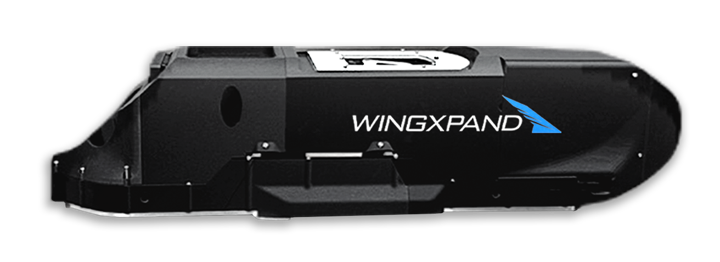
xPAIR’s open systems architecture was another aspect highlighted during the interview. When queried about WingXpand’s work with Raytheon, Madaras was excited to discuss the rapid integration of Raytheon’s IR autonomous identification software as evidence of this critical design element. The business partnership appears to be strong as WingXpand joined the RTX booth at the Association of U.S. Army (AUSA) Annual Meeting & Exposition at the Walter E. Washington Convention Center in Washington, DC.
Likewise, the WingXpand team has created a vertical takeoff and landing (VTOL) version of xRAI. This version allows operations in confined or urban environments where traditional fixed-wing launch is impractical. Once again, customer demand drove the evolution of their product. But our conversation didn’t just cover her business. I asked Michelle what women should consider when looking to join the drone industry. For her, women interested in the design and engineering side can certainly find openings. However, to her, anyone looking at a position in the drone industry will see a much broader set of opportunities than they might expect.
She was adamant, “There are so many jobs out there in terms of being a pilot, being in marketing and communications, being in business development, right? It’s a whole spectrum out there. It’s not just those purebred classical degrees that you may think of when you think of the aerospace industry.”
Beyond that, she believes in the added value of a different perspective that a diverse talent pool brings to the table. “We appreciate that people come from different perspectives…different walks of life, and that brings so much value. It brings fuel to the conversation. It brings fuel to the development process when you have people from different backgrounds that elicit details from the customers to build a better product at the end of the day.”
Perhaps those words come from a place of personal experience. By watching the use of drones in her first career, she has translated the needs she saw firsthand into a successful business. And, that is a lesson anyone can use for their future.
About WingXpand
WingXpand makes U.S.-built smart autonomous systems for air, land and water, along with the AI and autonomy software that powers them. Its smart planes, ground rovers and watercraft autonomously navigate, detect threats and deliver real-time alerts and intelligence. WingXpand serves the U.S. Army, Air Force, Navy, Special Operations, States and local entities, and Fortune 50 companies, among others. Its mission is to expand what’s possible for those who keep our world running, helping them see more, act faster and keep people out of harm’s way