


Building a culture of professionalism that extends beyond the individual.
“Who owns professionalism?” I asked that question during a recent Commercial UAV Expo roundtable focused on professionalism in the UAS/AAM industry. The first answer was straightforward: The individual. Every professional is responsible for their own decisions, behavior, and performance. But as the conversation continued, that answer became incomplete.
What about the organization? What about education? Regulation? Technology? Industry culture? And, what about the people who influence professional behavior long before someone enters the workforce?
That led to a broader conclusion: professionalism is not owned by one group; it is shaped by an ecosystem. The communities shape professionalism, and professionalism begins earlier than many of us recognize.
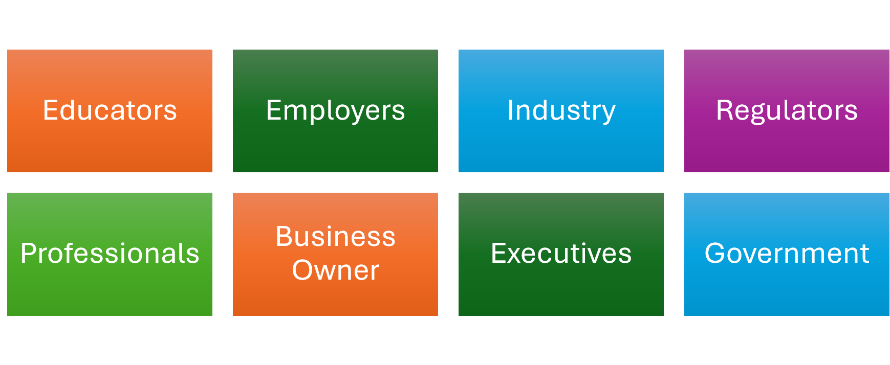
Parents and families help establish early lessons about responsibility, honesty, accountability, curiosity and how to treat others. They influence whether failure is something to hide or an opportunity to gain experience. Educators develop more than technical knowledge. Schools, colleges, instructors, and training organizations teach people how to learn, question, communicate, collaborate, and solve problems. Employers turn expectations into culture. Employees quickly learn what an organization rewards, tolerates, corrects, and promotes.
Industry establishes informal standards. Every industry has behaviors that become “normal.” The question is whether those norms strengthen or weaken professionalism. Regulators establish minimum requirements, safety expectations, accountability structures, and protections for the public. But regulations have limits. A regulator can establish a rule; it cannot legislate character or judgment. Professionals influence everyone around them. Experienced professionals become examples for those entering the field. Mentoring and coaching are therefore not simply career-development activities. They are mechanisms for transferring professional culture.
Manufacturers influence professionalism through design, documentation, training, reliability, safety features, human-machine interfaces, and support. Technology developers increasingly shape the environment in which people make decisions. As AI and autonomy become more capable, developers must consider not only what a system can do, but what it should do — and what should never happen without appropriate human judgment. Executives shape the conditions in which professionalism either thrives or erodes.
Leadership determines what gets funded, measured, rewarded, tolerated, and stopped. These communities do not operate independently. Their decisions interact. Consider a technically excellent professional entering an organization where raising concerns is discouraged. The individual may have strong professional values, but the culture can make those values difficult to sustain.
Or consider an excellent educational program preparing students for emerging careers. If employers evaluate candidates almost entirely by credentials, productivity, or prior experience, some of that development may never be recognized. A regulator can establish a safety requirement. A manufacturer can design a safer system. An employer can create a strong safety culture. A professional can make a responsible decision.
But if those elements do not reinforce one another, the gaps remain. That is the ecosystem problem. Professionalism is produced by the interaction of these communities. From workforce pipeline to workforce architecture. This perspective also reinforces an approach to workforce development I have been developing: Autonomy Workforce Architecture.
Workforce development is often described as a pipeline. But a pipeline suggests a linear process: people enter, receive training, obtain a job, and eventually exit. Yet, that is not how careers in an emerging industry work. People change roles, re-skill, become mentors, move into leadership, return to education, and/or transition between industries. This model views workforce development as a life cycle with six stages:
- Inspire and Prepare
- Develop and Train
- Credential and Connect
- Apply and Advance
- Advance and Lead
- Sustain and Strengthen
The principle is simple: Talent does not exit; it evolves within it.
Professionalism must evolve with the person. A student needs foundational professional behaviors. An entry-level employee develops technical judgment and learns how to collaborate. A manager becomes responsible for culture, accountability, and team development. An executive makes decisions that influence safety, trust, and workforce sustainability. A technology developer must consider the human consequences of design choices. The responsibility changes as the role changes.
Building an industry that people want to join.
If UAS and AAM are going to build a sustainable workforce, attracting people is only part of the challenge. The industry must also help people understand how to succeed once they arrive. That includes technical pathways, but it also includes the less visible elements of professional life: how credibility is built, how relationships are developed, how disagreement is managed, how leadership is demonstrated and when speaking up is necessary.
People entering an emerging field do not always have access to the same informal networks, mentors, or examples of professional advancement. Creating a culture where expectations are clear, rather than dependent on who already knows the unwritten rules, can make the industry stronger and more accessible. Professionalism can become part of that foundation.
So, who owns professionalism? We all do.
The UAS/AAM industry is still young enough to decide what kind of professional culture it wants to build. That is an opportunity. It is also a responsibility. Technology may become increasingly autonomous. Our systems may make more decisions, fly farther, and operate with less direct human intervention. But one thing should not become autonomous: our responsibility to one another. As our technology becomes increasingly autonomous, our responsibility to one another cannot.